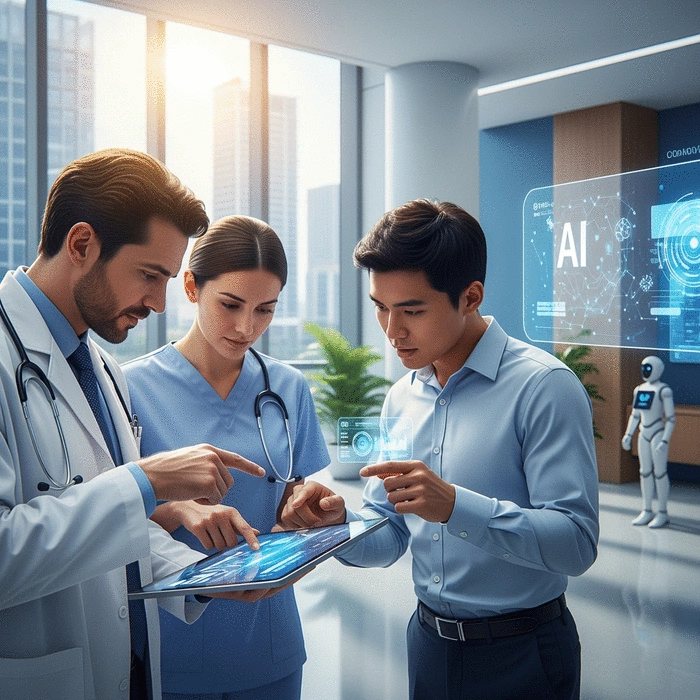
Enhancing Diagnostics & Treatment
- ✓AI-powered diagnostic tools (Alibaba Health, Baidu Health)
- ✓Advanced imaging algorithms (Yitu Technology)
- ✓Predictive analytics for patient management (Ping An Technology)
Join Zhenmind AI for expert analysis, startup spotlights, and global trend reports on AI innovation.
Posted on: 2025-11-05
By: Lian Zhao
As the healthcare landscape in China rapidly evolves, the role of AI startups is becoming increasingly prominent. How are these innovations reshaping patient care and operational efficiency? In this exploration, we uncover the transformative impact of artificial intelligence on one of the world's largest healthcare systems.
Chinese AI startups are transforming healthcare by focusing on three critical areas: enhancing diagnostics, improving operational efficiencies, and addressing ethical and privacy challenges. This visual highlights these key contributions. For a deeper understanding of how AI is being implemented across the sector, consider exploring AI's role in China's healthcare.
The healthcare landscape in China is evolving rapidly, driven by a unique blend of technology and cultural nuances. I’ve observed how the integration of artificial intelligence (AI) is not just enhancing operational efficiencies but also reshaping patient care practices. This transformation is crucial, especially in a country where over 1.4 billion people rely on a complex healthcare system. As we delve into this topic, let’s explore how Chinese AI startups are becoming key players in this field.
In this context, understanding the healthcare landscape in China is essential. The country's healthcare system is navigating significant reforms, aiming to provide better access to quality medical services. This is where AI comes into play, offering innovative solutions that promise to bridge gaps in care and improve overall patient outcomes.
The healthcare sector in China faces several challenges, including uneven resource distribution and a growing elderly population. As I investigate the latest innovations, I find that AI technologies are stepping in to address these issues effectively. By leveraging data analytics and machine learning, AI can optimize hospital operations and enhance patient care. The principles guiding these innovations often align with broader discussions on ethical AI practices in China, ensuring that technological advancements are implemented responsibly.
These challenges present an opportunity for startups to innovate. The need for accessibility and efficiency in healthcare drives the growth of AI applications. By understanding the unique challenges, we can appreciate the significance of AI innovations in this sector.
Chinese AI technology is quickly taking center stage in healthcare. Startups are developing solutions that not only enhance diagnostics but also improve logistical operations within hospitals. For example, AI algorithms can analyze vast amounts of patient data, assisting doctors in making informed decisions.
Through my research at Zhenmind AI, I’ve seen firsthand how these advancements are creating a surge of interest among healthcare professionals. The collaboration between technology and healthcare providers is essential for fostering an environment where AI can thrive.
Several key players are emerging within the landscape of Chinese healthcare AI startups. These companies are not only pioneering innovative solutions but also setting standards for ethical practices in AI. As we look at their contributions, it's clear that they have the potential to redefine healthcare delivery.
Among the notable startups, Alibaba Health stands out for its extensive health services platform. They leverage AI to enhance patient engagement and streamline medical consultations. Similarly, Ping An Technology applies AI in insurance and healthcare, focusing on predictive analytics to improve patient outcomes.
These companies are making significant strides in transforming healthcare through technology. Their innovative approaches are not only improving operational efficiencies but also enhancing patient experiences.
Moreover, Tencent Medical is revolutionizing patient interactions through AI chatbots and intelligent health management platforms. On the other hand, Yitu Technology is gaining recognition for its AI-driven medical imaging technologies, which are proving to be a game-changer in diagnostics.
As I reflect on the impact of these startups, I am excited about the potential for AI to reshape healthcare in China. Each innovation contributes to a holistic approach, enhancing both accessibility and quality of care.
As we explore the transformative role of AI in healthcare, we want to know your thoughts! What aspects of AI integration in healthcare excite you the most? Share your insights with us:
As we gaze into the future of Chinese healthcare AI startups, we see a landscape filled with potential and opportunity. The ongoing advancements in technology promise to redefine how healthcare is delivered, improving both efficiency and patient outcomes. However, as exciting as these developments may be, they also bring forth challenges—particularly in the realms of ethics and privacy.
In my experience with Zhenmind AI, I’ve seen how crucial it is for startups to not only innovate but also to prioritize ethical considerations. This balance will be key in fostering trust among patients and healthcare professionals alike.
As we integrate AI into healthcare, it's vital to address the ethical and privacy concerns that arise. Startups must navigate these issues carefully to maintain public confidence. Here are some of the most pressing challenges:
These challenges highlight the need for a comprehensive approach to ethical AI practices. As we see it at Zhenmind AI, the future of healthcare AI will depend on how effectively startups can address these issues. For further reading on this topic, consider the broader discussion on AI ethics in Chinese healthcare.
The horizon of Chinese healthcare AI is dotted with promising technologies that will likely shape the future. Innovations are emerging that promise to enhance diagnostic accuracy, streamline processes, and improve patient engagement. Here are some technologies to watch:
As I explore these advancements, it’s clear that the future of healthcare in China is not just about innovation—it's about creating a holistic system that considers both patient needs and ethical standards.
Healthcare automation is set to revolutionize medical imaging, making processes faster and more accurate. As startups continue to innovate, we can expect significant changes in how imaging data is processed and utilized.
The adoption of these automated technologies not only enhances efficiency but also empowers healthcare professionals to focus more on patient care, a mission that aligns closely with our values at Zhenmind AI.
Here is a quick recap of the important points discussed in the article:
AI startups in China are addressing critical challenges such as uneven resource distribution, the needs of a growing elderly population, and the demand for more personalized healthcare solutions. They achieve this by optimizing hospital operations, enhancing patient care, and improving access to medical services.
AI-powered diagnostic tools are enhancing accuracy in disease detection, improving workflow efficiency for medical professionals, and assisting doctors in making more informed decisions by analyzing vast amounts of patient data. Companies like Baidu Health and Yitu Technology are key players in this area.
Key players include Alibaba Health, known for online consultations; Ping An Technology, for predictive health analysis; Baidu Health, for medical imaging and diagnostics; Tencent Medical, for AI chatbots and health management; and Yitu Technology, for advanced medical imaging.
AI startups face challenges such as ensuring data privacy and security, preventing bias in AI algorithms, maintaining transparency in AI-driven care, and complying with evolving regulatory frameworks. Addressing these is crucial for building patient trust.
Promising next-generation AI technologies include Natural Language Processing (NLP) for interpreting unstructured data, AI chatbots for patient support and inquiries, advanced imaging algorithms for earlier disease detection, and blockchain technology for improved data security and interoperability.